

Currently Empty: ₹0.00



MBA
CAT 2026 Quant Trend Analysis: Which Topics Should You Focus On?
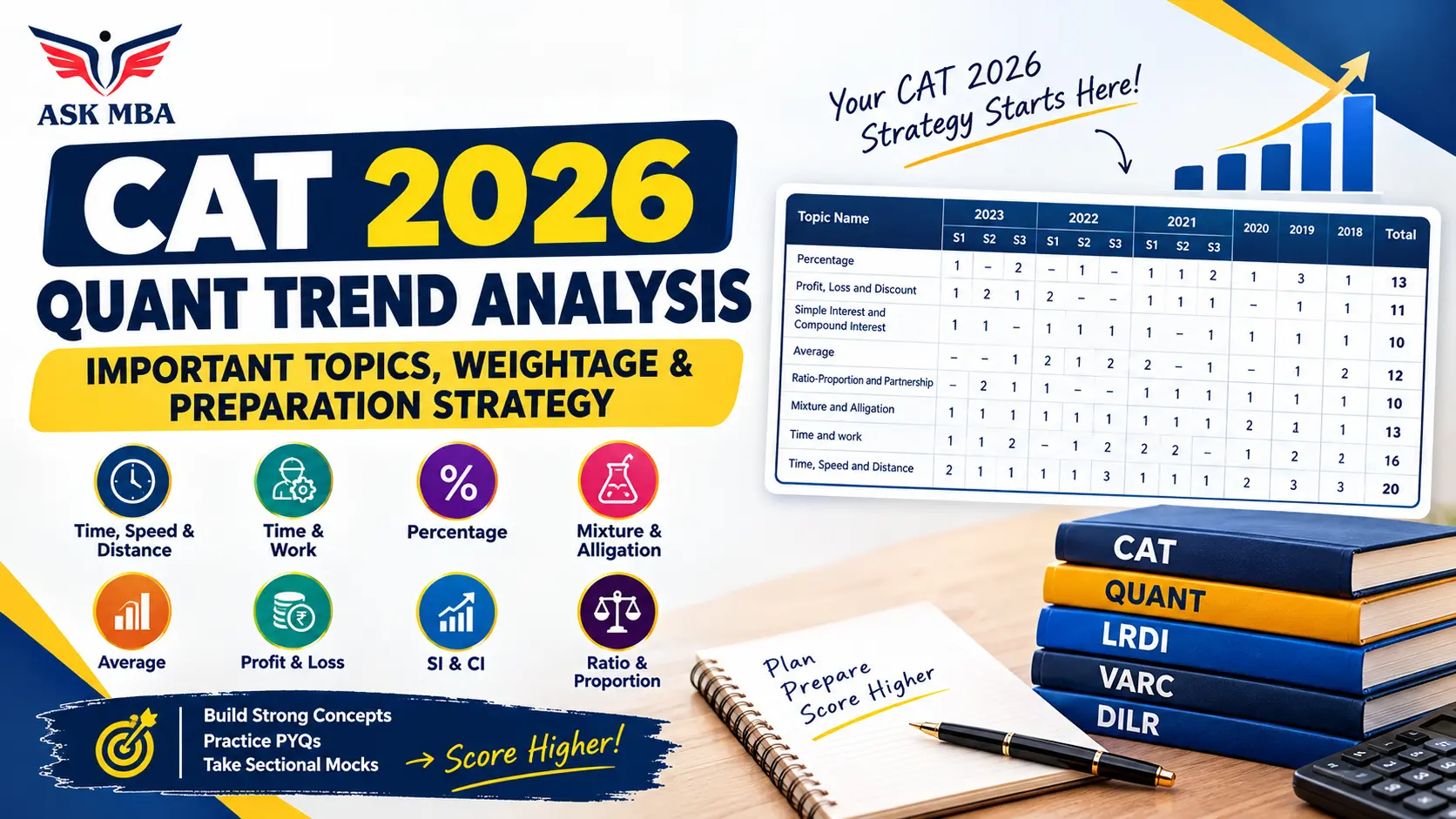
CAT 2026 Quant Trend Analysis: Which Topics Should You Focus On?
Preparing for CAT 2026 requires more than simply completing the Quantitative Aptitude syllabus. Understanding the previous CAT exam trends can help aspirants identify high-frequency topics, prioritize preparation and use their study time more effectively.
An analysis of CAT Quant questions from 2018 to 2023 shows that certain Arithmetic topics have consistently appeared in the examination. Among these, Time, Speed & Distance, Time & Work, Mixtures & Alligation, Percentage, Average, Profit & Loss, and Simple & Compound Interest deserve special attention.
For CAT aspirants, the key takeaway is simple: build strong fundamentals in high-frequency topics and combine concepts with extensive practice and mock tests.
CAT Quant Topic-Wise Trend Analysis
The following table shows the number of questions asked from selected Quant topics across CAT papers from 2018 to 2023.
| Quant Topic | 2023 | 2022 | 2021 | 2020 | 2019 | 2018 | Total |
|---|---|---|---|---|---|---|---|
| Percentage | 3 | 1 | 4 | 1 | 3 | 1 | 13 |
| Profit, Loss & Discount | 4 | 2 | 3 | – | 1 | 1 | 11 |
| Simple & Compound Interest | 3 | 3 | 2 | 1 | 1 | 1 | 10 |
| Average | 1 | 5 | 3 | – | 1 | 2 | 12 |
| Ratio, Proportion & Partnership | 3 | 1 | 3 | 1 | 1 | 1 | 10 |
| Mixture & Alligation | 3 | 3 | 3 | 2 | 1 | 1 | 13 |
| Time & Work | 4 | 3 | 6 | – | 1 | 2 | 16 |
| Time, Speed & Distance | 4 | 5 | 3 | 2 | 3 | 3 | 20 |
Note: The table reflects the topic-wise trend shown in the provided analysis graphic. A dash indicates that no question was recorded for that topic in that year.
Most Important CAT Quant Topics
1. Time, Speed & Distance – Highest Priority
Time, Speed & Distance (TSD) emerges as the most frequently represented topic in this analysis, with 20 questions across the years considered.
Important areas include:
- Speed, time and distance basics
- Relative speed
- Average speed
- Trains
- Boats and streams
- Races
- Meeting and crossing problems
TSD is particularly important because questions can combine multiple concepts and require both conceptual clarity and calculation speed.
Preparation tip: Master the basic formulas first and then move towards mixed and application-based problems.
2. Time & Work – High-Weightage Topic
Time & Work accounts for 16 questions in the analysis.
Key concepts include:
- Work efficiency
- Individual and combined work
- Work and wages
- Pipes and cisterns
- Men, machines and days
- Fractional work
This topic is closely connected to concepts such as LCM, ratios and efficiency, making it a useful area for developing problem-solving skills.
3. Percentage – A Foundation Topic
Percentage appears 13 times in the analysis and is one of the most important foundational concepts in Arithmetic.
Percentage concepts are frequently useful in other topics as well, including:
- Profit & Loss
- Discounts
- Simple & Compound Interest
- Mixtures
- Data Interpretation
- Ratio-based problems
Therefore, students should not treat Percentage as an isolated chapter.
4. Mixture & Alligation – Consistent Appearance
Mixture & Alligation also has a total frequency of 13 questions.
Important concepts include:
- Weighted averages
- Replacement
- Concentration
- Mixing two or more quantities
- Alligation rule
A strong understanding of ratios and averages can make Mixture & Alligation significantly easier.
5. Average – Frequently Tested Arithmetic Concept
The analysis records 12 questions from Average.
Students should focus on:
- Basic average
- Weighted average
- Combined average
- Average after addition/removal
- Average speed
- Applications involving ratios
Average is another topic that frequently overlaps with other areas of Quant.
6. Profit, Loss & Discount
With 11 questions in the analysis, Profit, Loss & Discount remains an important Arithmetic topic.
Key areas include:
- Cost Price and Selling Price
- Profit and loss percentage
- Marked price
- Discounts
- Successive discounts
- Dishonest dealing
Students should focus on understanding the relationships between CP, SP, MP, profit, loss and discount rather than memorizing formulas alone.
7. Simple & Compound Interest
Simple Interest and Compound Interest account for 10 questions in the analysis.
Important concepts include:
- Simple Interest
- Compound Interest
- Amount
- Rate and time
- Difference between SI and CI
- Compounding frequency
This topic can become scoring once the basic formulas and calculation techniques are clear.
8. Ratio, Proportion & Partnership
The analysis shows 10 questions from Ratio, Proportion & Partnership.
This is another foundational topic because ratios are extensively used in:
- Mixtures
- Averages
- Time & Work
- Partnership
- Profit & Loss
- Geometry and other Quant applications
Aspirants should develop strong ratio-based thinking instead of relying only on conventional formulas.
What Does the CAT Quant Trend Tell Us?
The biggest takeaway from the analysis is that Arithmetic continues to be extremely important for CAT Quant preparation.
Topics such as:
- Time, Speed & Distance
- Time & Work
- Percentage
- Mixtures & Alligation
- Average
- Profit & Loss
- Ratio & Proportion
- Simple & Compound Interest
should form a major part of an aspirant’s preparation strategy.
However, frequency should not be mistaken for a prediction of the exact CAT 2026 paper. CAT can change its question mix, difficulty level and topic distribution. Therefore, students should prepare the complete syllabus while giving additional practice to consistently important areas.
How to Prepare for CAT 2026 Quant?
Step 1: Build Your Concepts
Start with fundamentals rather than jumping directly into difficult questions.
For Arithmetic, build a strong base in:
Percentage → Ratio → Average → Profit & Loss → Mixtures → Time & Work → Time, Speed & Distance
These topics are interconnected, so learning them systematically can improve overall problem-solving ability.
Step 2: Practice Previous-Year Questions
After completing a topic, solve CAT previous-year questions.
This helps you understand:
- CAT’s question style
- Difficulty level
- Common concepts
- Time required per question
- Different approaches to the same problem
Don’t just check whether your answer is correct. Analyze how efficiently you solved the question.
Step 3: Develop Calculation Speed
CAT Quant is not only about knowing concepts. Speed and accuracy matter.
Work on:
- Mental calculations
- Fractions
- Percentages
- Approximation
- Multiplication techniques
- Squares and cubes
- Ratio-based calculations
The objective should be to reduce unnecessary calculation time.
Step 4: Take Sectional Mocks
Once your concepts and basic practice are complete, start taking sectional Quant mocks.
After every mock, analyze:
- Questions you got wrong
- Questions that took too much time
- Questions you left despite knowing the concept
- Calculation errors
- Questions where another approach would have been faster
Mock analysis is as important as taking the mock itself.
CAT 2026 Quant Preparation Strategy
A smart preparation strategy can be divided into three stages:
Phase 1 – Concept Building
Complete the fundamentals of Arithmetic and other Quant areas.
Phase 2 – Practice
Solve topic-wise questions, followed by mixed practice and CAT previous-year questions.
Phase 3 – Mocks & Analysis
Take sectional and full-length mocks, identify weak areas and continuously improve your selection strategy.
CAT 2026: Don’t Prepare Only by Weightage
While the trend analysis can help you prioritize, it should not become the only basis of your preparation.
For example, if Time, Speed & Distance has historically appeared frequently, it does not mean that CAT 2026 will necessarily contain the same number of TSD questions.
Instead, use the trend to decide:
What should I master first?
Then gradually cover the complete CAT Quant syllabus.
Key Takeaways for CAT 2026 Aspirants
📌 Time, Speed & Distance
The highest-frequency topic in this analysis with 20 questions.
📌 Time & Work
Another important topic with 16 questions.
📌 Percentage & Mixtures
Both have a frequency of 13 questions and are important Arithmetic foundations.
📌 Average
Recorded 12 questions and has applications across multiple Quant topics.
📌 Profit & Loss
An important scoring area with 11 questions.
📌 SI-CI and Ratio-Proportion
Both recorded 10 questions and should be included in the core preparation plan.
📌 Concepts + Practice + Mocks
The best preparation strategy is to build concepts, solve previous-year questions and take sectional mocks regularly.
Frequently Asked Questions – CAT 2026 Quant
Which is the most important Quant topic for CAT 2026?
Based on the historical trend shown in this analysis, Time, Speed & Distance has the highest frequency, followed by Time & Work. However, CAT does not guarantee a fixed topic-wise distribution every year.
Is Arithmetic important for CAT 2026?
Yes. Arithmetic topics such as Percentage, Ratio, Average, Profit & Loss, Time & Work, TSD and Mixtures are important areas to prioritize during CAT preparation.
Should I prepare only high-weightage topics?
No. High-frequency topics should be prioritized, but aspirants should eventually cover the entire CAT Quant syllabus.
Are CAT previous-year questions important?
Absolutely. Previous-year questions help aspirants understand CAT’s question patterns, difficulty level and preferred concepts.
How can I improve my CAT Quant score?
Focus on conceptual clarity, regular practice, calculation speed, previous-year questions and consistent mock-test analysis. Learning to select the right questions is equally important as solving them.