

Currently Empty: ₹0.00



MBA
Algebra Trend Analysis: Topic-Wise Question Trends from 2018 to 2023
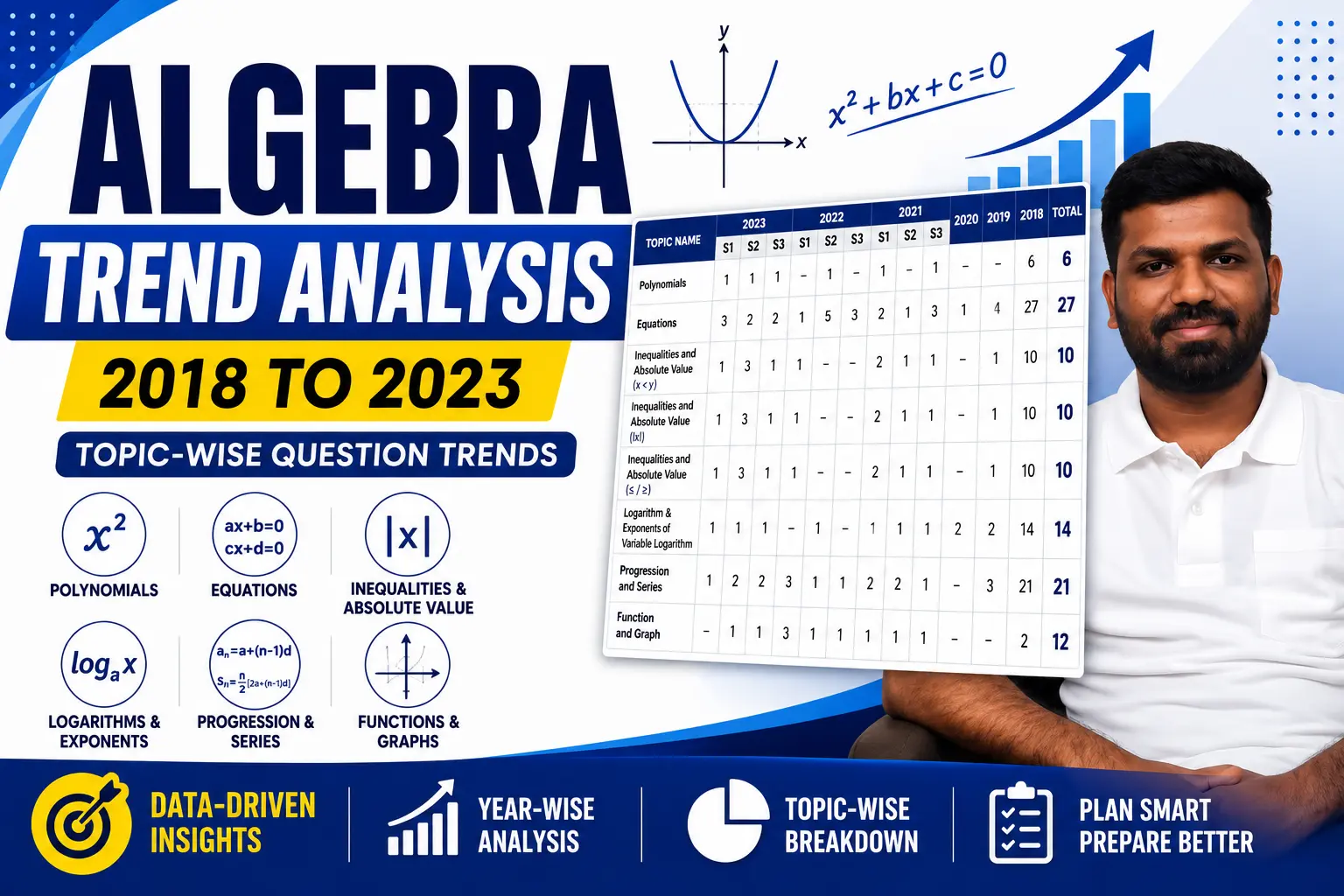
Algebra is one of the most important areas of Quantitative Aptitude for MBA entrance examinations. Understanding the previous-year question trend can help students identify high-priority topics, plan their preparation effectively, and focus more on concepts that have appeared consistently in the examination.
The following Algebra Trend Analysis presents a topic-wise breakdown of questions asked across different slots from 2021 to 2023, along with the overall question frequency from 2018 to 2023.
Algebra Trend Analysis – 2023 to 2018
The table below highlights the number of questions asked from major Algebra topics across different examination slots.
| Algebra Topic | 2023 S1 | 2023 S2 | 2023 S3 | 2022 S1 | 2022 S2 | 2022 S3 | 2021 S1 | 2021 S2 | 2021 S3 | 2020 | 2019 | 2018 | Total |
|---|---|---|---|---|---|---|---|---|---|---|---|---|---|
| Polynomials | 1 | 1 | 1 | – | 1 | – | 1 | – | 1 | – | – | 6 | 6 |
| Equations | 3 | 2 | 2 | 1 | 5 | 3 | 2 | 1 | 3 | 1 | 4 | 27 | 27 |
| Inequalities & Absolute Value – x < y | 1 | 3 | 1 | 1 | – | – | 2 | 1 | 1 | – | 1 | 10 | 10 |
| Inequalities & Absolute Value – |x| | 1 | 3 | 1 | 1 | – | – | 2 | 1 | 1 | – | 1 | 10 | 10 |
| Inequalities & Absolute Value – ≤ / ≥ | 1 | 3 | 1 | 1 | – | – | 2 | 1 | 1 | – | 1 | 10 | 10 |
| Logarithm & Exponents of Variable Logarithm | 1 | 1 | 1 | – | 1 | – | 1 | 1 | 1 | 2 | 2 | 14 | 14 |
| Progression & Series | 1 | 2 | 2 | 3 | 1 | 1 | 2 | 2 | 1 | – | 3 | 21 | 21 |
| Functions & Graphs | – | 1 | 1 | 3 | 1 | 1 | 1 | 1 | 1 | – | – | 2 | 12 |
Note: S1 = Slot 1, S2 = Slot 2 and S3 = Slot 3.
Which Algebra Topics Are Most Important?
The trend analysis clearly shows that some Algebra topics have been considerably more important than others over the years.
1. Equations – Highest Priority
Equations emerge as the most frequently tested topic in the given analysis, with a total of 27 questions.
Students should have strong command over:
- Linear equations
- Quadratic equations
- Simultaneous equations
- Roots of equations
- Relationship between roots and coefficients
- Application-based equations
Because equations have appeared consistently across multiple years and slots, this topic should be among the first priorities during Algebra preparation.
2. Progressions & Series
Progression and Series is another high-frequency Algebra topic, accounting for 21 questions in the trend analysis.
Important concepts include:
- Arithmetic Progression (AP)
- Geometric Progression (GP)
- nth term
- Sum of n terms
- Relationship between terms
- Application-based progression questions
Students preparing for competitive MBA examinations should be comfortable with both formula-based and logical questions from AP and GP.
3. Logarithms & Exponents
With 14 questions, Logarithms and Exponents also represent an important part of Algebra preparation.
Key areas to focus on include:
- Laws of logarithms
- Change of base
- Exponential equations
- Logarithmic equations
- Properties of logarithmic functions
- Variable logarithms
These questions can often be solved quickly once the fundamental properties are thoroughly understood.
4. Functions & Graphs
Functions and Graphs account for 12 questions in the available historical trend.
Preparation should cover:
- Basic functions
- Domain and range
- Types of functions
- Function operations
- Graph interpretation
- Transformation of graphs
- Maximum/minimum concepts through graphs
Understanding graphs visually can make many function-based questions significantly easier.
5. Inequalities & Absolute Value
The analysis shows repeated questions from Inequalities and Absolute Value, including different representations such as:
- (x < y)
- Absolute value (|x|)
- Inequality symbols (≤) and (≥)
These concepts require careful understanding of number lines, intervals, signs and solution sets.
6. Polynomials
Although Polynomials have a comparatively lower frequency in the table, they remain an important foundational Algebra topic.
Students should revise:
- Polynomial identities
- Factorisation
- Remainder theorem
- Factor theorem
- Roots and coefficients
- Quadratic and higher-degree polynomial relationships
Algebra Topic Priority for Preparation
Based on the historical frequency shown in the trend analysis, students can broadly prioritize Algebra topics as follows:
| Priority | Topic | Questions in Analysis |
|---|---|---|
| Very High | Equations | 27 |
| Very High | Progression & Series | 21 |
| High | Logarithms & Exponents | 14 |
| High | Functions & Graphs | 12 |
| High | Inequalities & Absolute Value | 10* |
| Moderate | Polynomials | 6 |
*The supplied trend sheet separately lists three inequality/absolute-value categories, so these should be studied as related subtopics rather than treated as three completely independent areas.
What Does the Trend Tell Students?
The historical data suggests that Algebra should not be treated as a low-priority section of Quantitative Aptitude. Questions have been distributed across several different concepts, with Equations and Progressions & Series showing particularly strong representation.
A smart preparation strategy is therefore to:
- Complete the basics of Equations first.
- Move to Progressions and Series.
- Strengthen Logarithms and Exponents.
- Practise Functions and Graphs.
- Cover Inequalities and Absolute Value thoroughly.
- Finish with Polynomials and mixed Algebra practice.
- Solve previous-year questions topic-wise.
- Gradually move from individual-topic practice to mixed Algebra sets.
How to Prepare Algebra Effectively
Step 1: Build Conceptual Clarity
Do not begin Algebra preparation by memorising formulas alone. Understand what each formula represents and when it can be applied.
Step 2: Create a Formula Sheet
Maintain a concise formula sheet covering:
- Quadratic equations
- AP and GP
- Logarithms
- Exponents
- Inequalities
- Functions
- Polynomial identities
Revise this sheet regularly.
Step 3: Solve Previous-Year Questions
Previous-year questions are one of the best ways to understand the actual difficulty level and recurring patterns.
After completing each topic, solve questions from multiple years and slots.
Step 4: Practise Under Time Pressure
Once your concepts are clear, solve Algebra questions using a timer. MBA entrance examinations reward both accuracy and speed.
Step 5: Analyse Mistakes
Maintain an error log. Categorise every mistake as:
- Conceptual error
- Calculation error
- Formula error
- Question-selection error
- Time-management error
This will help improve your performance much faster than simply solving more questions.
Frequently Asked Questions (FAQs)
Which is the most important Algebra topic?
Based on the provided historical trend, Equations has the highest frequency, with 27 questions recorded in the analysis. Progression & Series follows with 21 questions.
Is Algebra important for MBA entrance exams?
Yes. Algebra forms an important part of Quantitative Aptitude and includes several recurring concepts such as equations, progressions, logarithms, inequalities, functions and polynomials.
Which Algebra topics should I study first?
A practical order is Equations → Progression & Series → Logarithms & Exponents → Functions & Graphs → Inequalities & Absolute Value → Polynomials.
How should I use previous-year Algebra trends?
Use trend analysis to prioritize your preparation, not to predict the exact questions that will appear. Every topic should eventually be covered, but high-frequency areas deserve more practice and revision.
Final Takeaway
The Algebra Trend Analysis from 2018 to 2023 shows that questions have been consistently asked from multiple Algebra concepts across different examination slots. Equations and Progression & Series stand out as the highest-frequency areas, while Logarithms, Functions, Inequalities and Polynomials should also be included in a complete preparation strategy.
For students preparing for MBA entrance examinations, the ideal approach is to combine concept building + previous-year questions + timed practice + regular revision. Trend analysis can help you decide where to spend more time, but complete syllabus coverage remains essential for a strong Quantitative Aptitude score.