

Currently Empty: ₹0.00



GDPI
Top MBA HR Interview Questions & Answers – Complete Preparation Guide
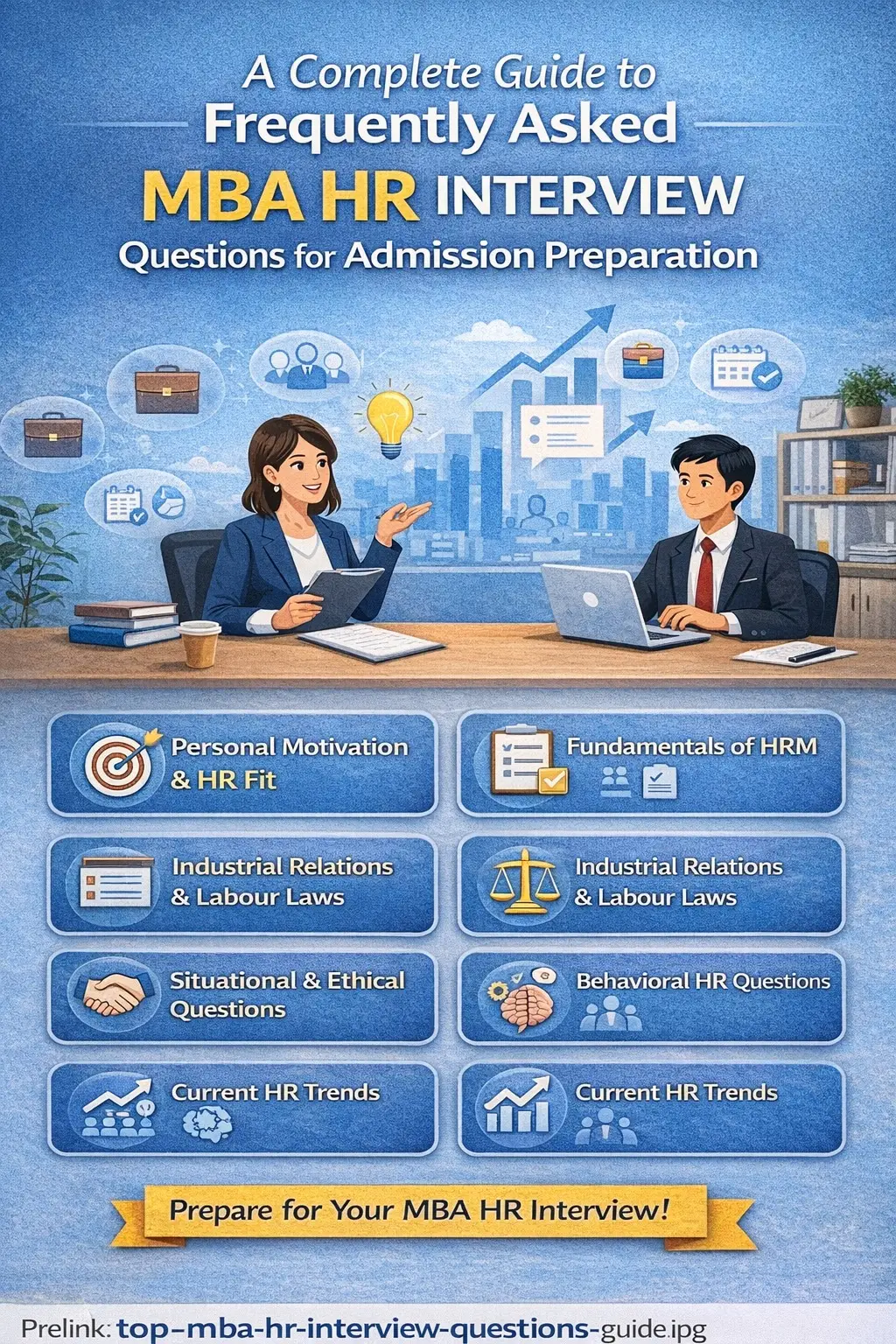
Top MBA HR Interview Questions & Answers – Complete Preparation Guide
Preparing for an MBA in Human Resource Management (HR) interview requires more than just textbook knowledge. HR panels focus on your intent, attitude, ethics, and people-handling ability along with your understanding of HR concepts and current trends.
This blog covers the most important MBA HR interview questions categorized into motivation-based, technical, practical, and situational areas to help you prepare confidently.
1. Personal Motivation & HR Fit (Most Critical)
HR interview panels focus heavily on your intent and personality. These questions test whether you truly understand the role of HR and are suitable for it.
Common questions include:
- Tell me about yourself.
- Why MBA and why HR specifically? Why not Marketing or Finance?
- What qualities make you suitable for HR?
- Do you think HR is a “soft” function? Defend your answer.
- What kind of HR professional do you want to become?
- What are your short-term and long-term career goals in HR?
- Who is your role model in HR or leadership and why?
These questions assess clarity of purpose, emotional intelligence, and long-term commitment to HR.
2. Fundamentals of Human Resource Management
Strong concept clarity is essential in HR interviews. Interviewers begin with basic HR definitions and functions.
Important questions include:
- What is Human Resource Management?
- What are the main functions of HR?
- Difference between Personnel Management and HRM.
- What is Talent Management?
- Explain Recruitment vs Selection.
- What is Performance Appraisal?
- What is Training and Development?
- What is Compensation Management?
- What is Employee Engagement?
- What is Employer Branding?
These questions test your understanding of how HR supports employees and organizational growth.
3. HR Specializations & Practical Understanding
Interviewers expect awareness beyond theory and textbooks.
Key questions include:
- What is the role of HR in organizational strategy?
- What is HR Analytics?
- How can HR contribute to company profitability?
- Difference between Line Manager and HR Manager.
- What is Competency Mapping?
- What is Succession Planning?
- What is Organizational Culture?
- What is Change Management?
These questions assess whether you can connect HR practices with business outcomes.
4. Industrial Relations & Labour Laws (Very Important)
Especially important for institutes like XLRI, TISS, IITs, and top HR programs.
Frequently asked questions:
- What are Industrial Relations?
- What causes Industrial Disputes?
- What is a Trade Union?
- What is Collective Bargaining?
- Difference between Strike and Lockout.
- What is the role of HR in handling strikes?
Important Indian Labour Laws (know at least 3–5):
- Factories Act
- Industrial Disputes Act
- Minimum Wages Act
- POSH Act
- EPF & ESI Acts
Also prepare:
- What is the role of HR in ensuring legal compliance?
5. Situational & Ethical HR Questions (Very Common)
These questions test your judgment, fairness, and ethics.
Examples:
- How would you handle a conflict between two employees?
- What would you do if a top performer is toxic?
- How would you handle employee dissatisfaction?
- What would you do if management asks you to fire employees unfairly?
- How would you handle sexual harassment complaints?
- What would you do if an employee is underperforming?
Panels want to see balanced thinking between employee welfare and organizational policy.
6. Behavioral & Personality-Based Questions
Since HR deals with people, personality-based questions are very important.
Common questions:
- Describe a leadership experience.
- Tell me about a time you resolved a conflict.
- How do you handle pressure and criticism?
- Are you comfortable saying “no” to senior management?
- How do you maintain confidentiality?
- What are your strengths and weaknesses for HR?
These questions reveal emotional intelligence and communication skills.
7. Current Affairs & HR Trends
Modern HR interviews always include questions on current HR trends.
Important topics:
- How has AI impacted HR?
- What is hybrid work culture?
- What is quiet quitting?
- What is employee burnout?
- How are companies retaining talent today?
- What is DEI (Diversity, Equity & Inclusion)?
- What HR challenges do Indian companies face today?
- Which company’s HR practices impress you and why?
This section checks your awareness of real-world HR challenges.
8. Profile-Based Questions (Tailored to You)
These depend on your background and experiences.
Common questions:
- Why HR with your academic background?
- Do you have experience dealing with people or teams?
- Have you handled conflicts before?
- What HR skills do you already possess?
- What HR skills do you want to develop during MBA?
- Why should we select you for HR specialization?
Prepare personalized answers for these questions.
9. Stress & Counter Questions (Be Prepared)
These questions test your conviction and confidence.
Examples:
- HR is a cost center. Do you agree?
- Anyone can do HR. What is special about you?
- Why would employees trust you?
- What if employees manipulate you emotionally?
- Will you side with employees or management?
Your answers should reflect balance, maturity, and ethical thinking.
10. Questions You Can Ask the Panel (Very Important)
Always ask intelligent questions to show interest in HR and the institute.
Examples:
- How does your institute prepare students for real HR challenges?
- What kind of live HR projects are offered?
- How strong is the institute’s Industrial Relations exposure?
- How does the curriculum align with industry HR needs?
How to Answer HR Questions – Golden Rule
Use this simple framework:
Situation → HR Principle → Action → Outcome
Example:
“In a conflict situation, my approach would be to first listen to both parties impartially. Based on HR principles of fairness and transparency, I would mediate a discussion and work toward a mutually acceptable solution. This builds trust and maintains harmony in the workplace.”
Conclusion
MBA HR interviews test your intent, ethics, people skills, and business understanding. Preparing across personal, technical, legal, and situational questions will give you a strong edge.
A successful HR candidate demonstrates:
- Clarity of purpose
- Empathy and fairness
- Strong communication
- Awareness of HR trends
- Knowledge of labor laws
pranita sable
This MBA HR interview breakdown is very practical especially the way behavioral questions are explained with structure.
Mayur Shinde
The real Interview examples shared here make it much easier to understand what panels actually expect